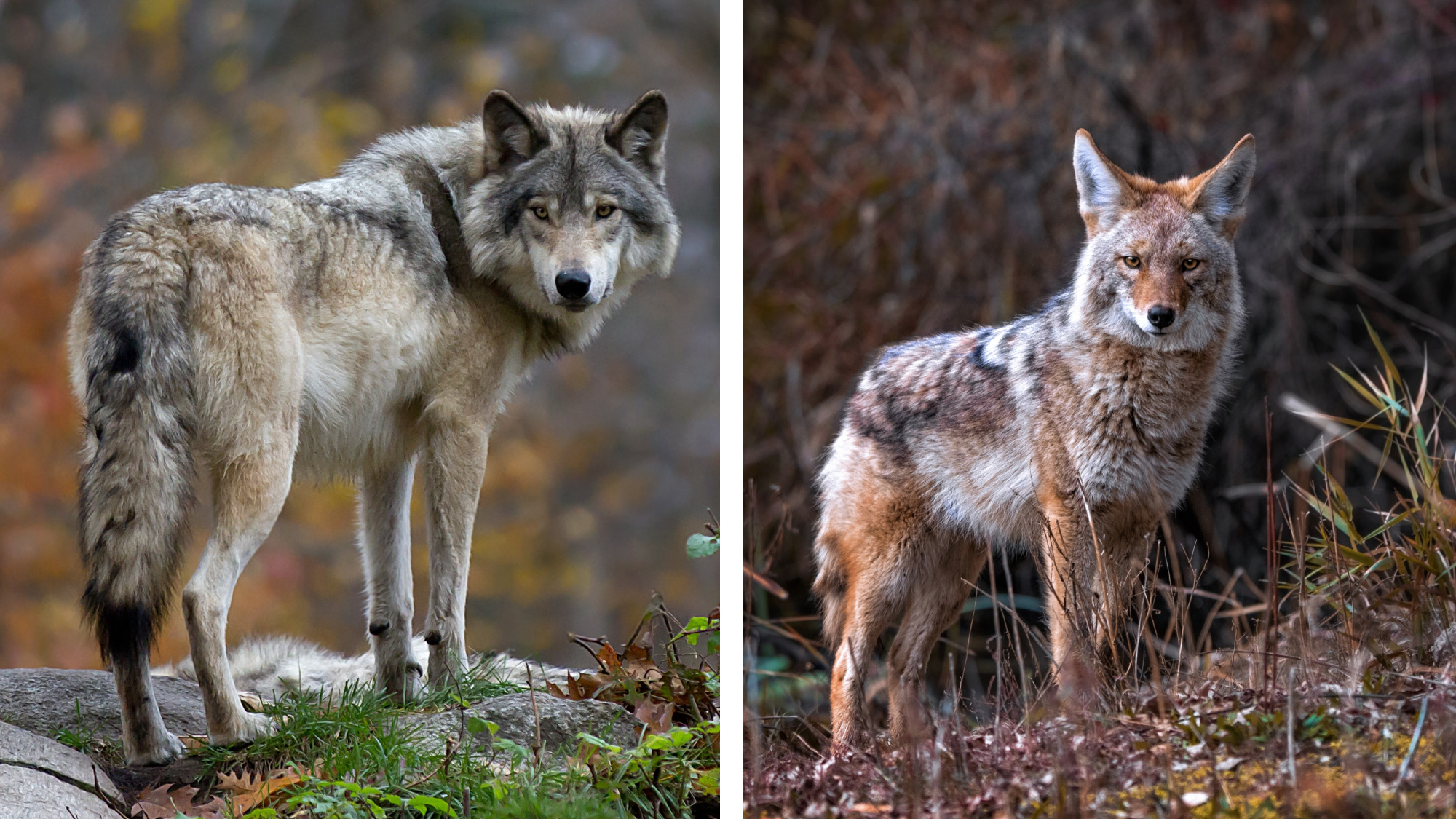
Information and stories about San Francisco coyotes: behavior & personality, coexistence & outreach, by Janet Kessler: Unveiling first-hand just how savvy, social, sentient and singular coyotes really are!
2) A VIDEO ON COYOTE BEHAVIORS, GUIDELINES & DOGS: a one-stop video, by me, on urban coyote behavior and how to coexist with them, how to handle encounters, and why culling doesn’t solve issues:
*A protocol clarification for when walking a dog (not addressed in the video): Your safest option always is flat-out, absolute AVOIDANCE: Whether you see a coyote in the distance, approaching you, or at close range, leash your dog and walk away from it, thus minimizing any potential dog/coyote confrontation or engagement. If you choose to shoo it away, follow the guidelines in the videos, but know that what’s safest is proactive, preventative unmitigated avoidance: i.e., walk away.
2) MORE LINKS TO COYOTE BEHAVIOR & DOGS:
Press on image above for another crash course on coyotes
For more information on dogs and coyotes, type DOG or DOGS (plural) into the “search” box at the top right of the blog to bring up many dog/coyote related postings with a lot of information to increase understanding of dogs and coyotes. I don’t know why using plural brings up different articles, but it does!
“If you talk to the animals they will talk with you and you will know each other. If you do not talk to them you will not know them, and what you do not know you will fear. What one fears one destroys.” Chief Dan George
Charles Wood, a frequent contributor to Coyote Yipps, adds: “I want to try and express Chief Dan George’s words a little differently, though I believe the meaning is the same: ‘If you talk to the animals they will talk to you and you will come to know them. When you come to know them, you will love them, with respect, without fear. What one fears one destroys. What one loves one defends.'”
I realize my local coyote, regionally, have seemed to change greatly. I used to hear them regularly. Or see them in distance, checking the dogs out. This has mostly ceased. They are here. I see as many signs (scat, footprints) as ever. But they literally, all of them, have become ghostlike. Now, they even rarely defy the dogs via calls and never come in our direction.
After talking with local ranchers, hunters, and some tribal members, the general consensus is the wolves have altered their behaviors. The coyote are still thriving, but they seem to only challenge lone wolves, and this during pup denning.
Otherwise, it seems they’ve truly become ghost-like. There are at least 2 packs locally, and some loners. The two territorial packs regularly sweep their areas in hunts and patrols. And any stranger canids they meet often are chased off if lucky, run down if not lucky or slow.
For hunters, this means large hounds no longer are able to hunt etc. They are loud, isolated and cannot cope with territorial wolves, who simply see them as trespassers on the loudest scale.
Coyote don’t have the issues hounds have. . .but face the same dangers. Wolves DO NOT tolerate them. So. . .they’ve become ghosts. Truly.
I’m glad coyotes have adapted instantly to local wolves. But admit, am shocked at the complete change. I always thought of coyote as very vocal and fairly easy to spot. This elusive, ghostlike, quieter type….is new to me. I miss their calls and songs. They are still everywhere. But now…are never predictable in sight or sound.
Warmly
Lou
[PS from Janet: I’ve noticed this type of change, on a smaller scale, when new huskies began coming to one of the parks. The huskies pursue the coyotes to the point where now the coyotes (in one particular park) are sticking to peripheral areas where they can quickly flee into hiding. We aren’t seeing them as regularly as before: not quite as stark as your change, but nevertheless a palpable change due to a threat.]
I’ve written several postings with information about mange. One on how the malady has just recently exploded here in San Francisco, and another on how weakened immune systems allowing the mange mite to proliferate on a coyote host have been linked to the use of rat poisons. But there are other stressors which raise cortisol which in turn weaken immune systems, allowing the mite to take over. An interesting correlation (maybe related) is that San Francisco’s coyote population might have reached an over-saturation point, as indicated by territories being divided up and shared at the same time that mange has spread wildly through the city. It’s this correlation that I’m attempting to point out.
2024 marked the breakup of one of San Francisco’s long-term stable coyote territories: This territory had been stable since 2007. The shift began when Scowl, the alpha male, left his older mother-turned-mate, Chert, after two years of fathering and raising a family of pups with her. Whether age played a role, I don’t know — but he soon turned up with a younger female, Bonus, on her much smaller territory, where they had pups that year.
Left behind was Chert, aging, along with three yearlings. Several new males passed through, but appear to have been rejected. the one who remained for several weeks had mange. Within months Chert and her offspring had mange. In addition, this is when a mangy “squatter” pair of coyotes moved into a portion of her territory, maintaining their separation from Chert’s family. Their pups did not survive, and the pair left by early summer — but the area had effectively become shared space.
2024 was also the year mange appeared to take hold across the city.
After Chert died towards the end of the year, 2024, two of her offspring remained and claimed the southern portion of what had once been her and Scowl’s shared domain. This kind of territorial inheritance — offspring retaining natal land — has characterized this lineage since 2007. In fact, it characterises a number of San Francisco’s territories, but not all of them.
Meanwhile, Scowl eventually led Bonus back to his former territory, reclaiming the northern section. By 2025, what had once been a single large territory was permanently divided in two. The families are closely related — both are offspring of Chert’s from different years — but they never interact, maintaining a firm boundary.
Another divided territory: Scout’s story
Scout originally acquired her territory after it was vacated — a rare and lucky find. Yet in 2022 she denned about a mile away, possibly because of her mate Scooter’s family ties there. Even so, during this time, she continued returning to her original territory, where earlier offspring remained, almost as if holding it for her.
In 2023 she returned to her original old territory full-time with a new mate, Skipper, and they stayed for two seasons. But in 2025, one of Scout’s daughters resisted dispersal. So it was Scout and Skipper then who abruptly left, returning to the territory she had denned in a mile away, where they squeezed the other claiming family into a less desirable portion of the park.
That displaced family developed severe mange; Scout and Skipper had milder cases but recovered. Once again, the territory appears permanently divided, with mange disproportionately affecting the weaker group.
Shared space and shifting use
In 2025, two families shared the Sunset area, using the same passageways at different times of day or evening. Both alpha pairs had serious mange.
A similar pattern is now emerging in a denning area of West Portal. After Mouse — the territorial female — was killed by a car in 2022, the area became something of a no-man’s-land. Coyotes came and went: loners, then pairs. But by 2024-25, three mangy pairs were using this small area regularly.
An open question
Across these examples, territorial divisions and shared-use areas appear to coincide with mange outbreaks beginning in 2024. Population pressure appears to be driving these divisions. Does crowding and social stress increase vulnerability to disease and accelerate its spread? I don’t know whether these patterns are causal or coincidental.
I’ve simply observed the overlap. Determining whether one feeds the other is a question best left to someone with an infectious-disease background — but the pattern itself is becoming hard to ignore.
This is Cricket from the Presidio. Although I don’t (yet) know that he is the individual who swam to Alcatraz, it would have been a coyote in the same phase of life: just two years old and desiring a territory of his own. On Crissy Field he would have learned the patterns of the tides from regularly patrolling the area.
A Behavioral Reconstruction
I almost always post my own first-hand observations of coyotes, supported by photographs. This case is different. The coyote’s crossing to Alcatraz Island on January 11th came to me second-hand. What follows is therefore a combination of documented sightings, dates, tide information, and physical geography, with behavioral interpretation drawn from research and from nearly 20 years of observing coyotes. Where motivation or decision-making is discussed, it reflects informed behavioral inference rather than direct observation.
The Event
The coyote arrived on the island at 3:24 p.m. on January 11th. He was not seen again until January 24th, nearly two weeks later, and he has not been observed in the last two weeks — I did not see him when I was there this week.
This posting discusses the environmental conditions and behavioral context explaining both how the crossing could have occurred and why the coyote probably would have eventually ended up leaving.
It has been proposed that this coyote had been swept away while chasing prey near the shore, or attempting a shorter crossing, only to be carried toward the island by powerful ebbing or surging currents.
Indeed, ferry crews reported strong currents that day — 8 to 9 knots (about 10 mph). For context, even an Olympic swimmer would struggle against a 2-knot current. That day’s peak currents were amplified by heavy freshwater runoff from recent winter storms.
However, this swept away theory diminishes any intention on the part of the coyote and underestimates his intelligence and drive to survive.
San Francisco’s coyote population is essentially saturated, with at least 20 known families (see my map and research HERE). It is just as likely that this coyote chose Alcatraz — planning the swim to escape territorial pressure. Alcatraz was unclaimed territory with a dense food base, something he could have sensed.
Birds were everywhere: Cormorants, Sea Gulls, Geese. Apparently Snowy Egrets and Herons also nest there.
Currents, Not Tide Tables
San Francisco Bay has two high tides and two low tides daily, driven primarily by lunar pull. Tide tables show when water levels rise and fall, but they do not indicate how fast the water is moving. For any swimmer — human or animal — current speed and direction matter far more than water level.
When currents reverse direction — from in to out or out to in — there is a period known as slack water, when horizontal movement slows dramatically or stops. Slack water does not necessarily coincide with high or low tide, particularly in San Francisco Bay, where channel depth, shoreline shape, wind and fresh water runoff affect timing. Because of the massive volume of water passing through the narrow Golden Gate, slack water lags behind tide changes.
On January 11th, as measured by different stations, the relevant tides were as follows:
Presidio Station (#9414290) recorded low tide at 12:41 p.m. and high tide at 7:25 p.m.
Alcatraz Station (#9414792) recorded low tide at 1:18 p.m. and high tide at 8:05 p.m. (Alcatraz is further into the Bay, so later).
After low tide, current strength increased, then began reversing direction. By approximately 3:24 p.m., surface flow was shifting inward (flood phase), though strength varied by location.
Slack periods can last up to 30 minutes, especially near shorelines, within eddies, and around islands. During slack water, the Bay may still appear visually low, with exposed rocks or mudflats, yet horizontal movement can be minimal. This distinction is critical: slack water — not tide tables — creates the viable window for crossing.
For the Crissy Field–Alcatraz route, the most relevant data comes from Golden Gate Bridge Station SFB1203: Slack time is 3:34 pm. Human swimmers attempting the “Alcatraz Cross” typically aim for this time frame, which provides about 15–20 minutes of neutral water.
How long does “swim-able” water last? If you define “slack” as water moving less than .5 knots (which is calm enough for a human or coyote to swim straight), the window is not long: on a normal day it could last 30 to 45 minutes. During January, there were King Tides, higher tides, which is when the coyote swam, it would be shorter than that.
This is where the story gets really fascinating—and a little bit miraculous for the coyote. If his arrival was at 3:24 PM, the coyote actually timed its swim almost perfectly, albeit possibly by accident. San Francisco Bay is one of the most famously tricky bodies of water to navigate in the world.
TIMELINE: The Crossing on January 11
A standard ebb tide flows West, out toward the Pacific Ocean. If a coyote jumped into a strong ebb at Crissy Field, he’d likely end up under the Golden Gate Bridge or heading for the Farallon Islands, not Alcatraz.
However, the “Alcatraz swim” scenario relies on a specific local phenomenon called the Counter-Current (or eddy), combined with the timing of the transition. Here is how that “impossible” swim actually works:
1. The “Crissy Field Eddy”
While the main “river” of water in the middle of the Bay flows West during an ebb, the water right along the shoreline at Crissy Field doesn’t always follow the rules. Because the San Francisco waterfront is jagged, the outgoing water “trips” over the land, creating a massive circular eddy.
While the center of the channel is rushing West, a smaller loop of water near the shore often flows East back toward the city.
This would have given our coyote a “free ride” toward the East in the initial leg of his journey.
2. The Power of “Slack Before Flood”
He then arrived on Alcatraz ten minutes before slack. Slack is that brief, magical window where the water stops moving before it reverses direction.
2:20 PM: The ebb is weakening. A strong swimmer (or a determined coyote) can fight a weak current, but they mostly use the shoreline eddies to move East.
2:45 PM: As he moves toward mid-channel, the outbound (Westward) current is dying out. At this stage, the “push” West is no longer a 4-knot treadmill; it’s more like a lazy river.
3:24 PM: The coyote reaches Alcatraz just as the water goes still.
3. The “Alcatraz Cone”
Alcatraz sits like a giant rock in a stream. During an ebb, there is a “shadow” of calm water (and sometimes a reverse swirl) directly behind the island (the East/South-East side). If he timed his crossing to hit that “shadow” as the ebb faded, the water would actually pull him into the island rather than pushing him past it.
Summary of the “Coyote Physics”
Time
Location
Current Action
Coyote’s Strategy
2:20 PM
Crissy Field
Weak Ebb / Shoreline Eddy
Uses the Eastbound eddy to gain ground toward the city.
2:45 PM
Mid-Channel
Dying Ebb
Rows/swims across the weakening Westward flow.
3:24 PM
Alcatraz
Slack Water
Arrives when the “treadmill” has stopped completely.
In short: the tide wants to take him West, but by hugging the shore to use the eddies and timing the crossing for the “death” of the ebb, he turns a Westward tide into an Eastbound shortcut.
Although peak currents earlier in the day reached 8–9 knots, by 3:24 p.m. those forces had essentially zeroed out. He quite literally threaded the needle between two powerful movements of water.
Why the Marina–Crissy Field Route Was Most Likely
The strongest currents in San Francisco Bay occur beneath the Golden Gate Bridge and within deep shipping channels. Along the Marina and Crissy Field shoreline, however, water movement frequently breaks into eddies, counter-currents, and temporary low-energy zones of reduced flow, particularly during slack periods.
This shoreline offers gradual entry, minimal surf, and a clear visual line toward Alcatraz. It is a recognized low-energy/slow current crossing area used by open-water swimmers.
This coyote, by the way, is not from the North Beach family — all members of that family were accounted for after January 11th — so he originated elsewhere — and I’m speculating here that he might have come from the Presidio. I was hoping to get a photo of his face — I know a great many of the coyotes in San Francisco by their faces and might have been able to tell which family he was from.
Although ferry crews reported strong currents, peak flows are not continuous. The crossing almost certainly occurred during a brief lull when conditions aligned favorably.
Water could be seen in deep puddles, but also there were hoses for watering the gardens, and a ranger told me that cleaning vehicles regularly left plenty o water on the parade ground.
Landing on Alcatraz: Intentionality
The coyote emerged on the east–southeast side of Alcatraz, an area sheltered by a hydrodynamic shadow created by the island’s shape. The south and west faces experience stronger, more chaotic currents. The coyote’s landing was not likely a random landing: it was more likely consciously chosen.
There is significant evidence to support the theory that this was an intentional “mission”. So even, say, if he had been “swept” to the island unintentionally, I want to share this alternative scenario here.
From the San Francisco shoreline, Alcatraz is a fixed and highly visible target. For a dispersing coyote seeking unclaimed territory, it could appear as a “promised land.” January is a period of heightened territorial drive. While coyotes do not swim for recreation, they are intelligent and daring. This coyote probably saw the island as a potential territory and decided to “push the envelope”.
If he entered the water near Crissy Field or even the Embarcadero, he didn’t just “float” there; he had to maintain a specific heading to keep from being swept past the island. That requires active navigation. Coyotes use their front paws to paddle and their tails as a rudder. While he showed “steadfast determination,” the fact that he arrived shivering, depleted, and near-hypothermic suggests he did not fully anticipate the “harrowing experience” of the 1.25-mile crossing.
The chosen landing area is comparatively low-energy, climbable, and adjacent to calmer water. This apparently is consistent with how land mammals typically select exit points after water crossings. Animals do not enter water blindly — not coyotes, not wolves, not dogs. They test conditions repeatedly, feeling resistance with their paws, watching floating debris and foam, observing surface texture, and even smelling the water. Moving water smells different from still water. At slack water, surface movement loses directionality and resistance drops — these are changes animals readily detect.
Coyotes, wolves, and foxes are exceptional pattern learners. They patrol the same shorelines repeatedly, associating light, sound, wind, and bodily feedback with outcomes. Before attempting a long swim, this coyote more than likely had prior experiences entering the water, being pushed or rolled, and learning when not to try again!
There is strong comparative evidence — from seals, river-crossing wolves, Indigenous coastal peoples, and modern SF Bay swimmers — that crossings are timed around calmer water. Animals read the Bay directly, they don’t need charts!
Coyotes are “risk-aware.” He would not have been “stupid” enough to get swept away. If he went into the water, he likely knew he was capable of finishing the job. The “panting and shivering” seen in the video wasn’t a sign of failure; it was just the physical toll of a high-intensity workout in a cold “gym.”
He did not, and would not have chosen or gone to Angel Island which would have been a death trap for an outsider. Angel Island is much smaller (1.2 square miles) than a regular territory in San Francisco that runs 2.5 square miles. And Angel Island’s population of coyotes is 14-17, one family unit, on 1.2 square miles — that is crowded. Outsiders are not welcome and he would perish.
Coyotes are survivors first, explorers second.
The coyote’s footprint, a dead mouse, Sea Gulls drinking fresh water from a puddle. But did you know that many sea birds have a gland in the corner of their eyes that desalinates saltwater, so they can actually live on seawater!
The Swim
The crossing distance would have been approximately 1.2 to 1.4 miles, likely not in a perfectly straight line. A reasonable swimming speed for a coyote in calm water is 1.0 to 1.5 miles per hour, suggesting a swim lasting roughly 60 to 75 minutes at a steady, aerobic pace.
For land mammals, water is cold, disorienting, energetically costly, and limits defense. For this reason, animals choose exit points before entering water. Entry and exit are part of a single decision. A suitable exit would include solid footing, calmer water, climbability, and a solid shoreline scent. Calm water carries scent more effectively, while strong currents smear it.
Although luck might have been involved to some extent, this journey more likely involved competent environmental decision-making!
Why Alcatraz — and Why Leave
Islands offer short-term advantages: fewer predators, fewer competitors. Coyotes apparently evolved in fragmented, dynamic landscapes — floodplains, river islands, and edge habitats — and crossing water to reduce territorial chaos is a known survival strategy.
And with the existing “dense calorie” environment — a “high quality patch” — on Alcatraz, the small territory would serve him well when it comes to nourishment — whether he actually catches the birds or not — a ranger told me that his staff constantly picks up dead birds on the trail and toss them.
A reason keeping this coyote from leaving the island might be if he was become instinctively wary of entering the water after his difficult swim. He looked worn out in the video, but, then again, any athlete, human or canine, would have been winded and cold after a mile long battle in frigid waters. If he was a healthy, dispersing young coyote, he likely had the muscle and drive to make the swim — a calculated risk rather than an accident. However, without the exact same “threading the needle” of tides he used to arrive, he could be swept out to sea. So why leave?
Being the intelligent animal coyotes are, he would get bored on Alcatraz: most of that is rock and concrete structures, with just a few tiny gardens and puddles of water which might soon dry up. So, while he may have won the “security lottery,” he has essentially moved into a very small, very boring luxury apartment with no plumbing. Coyotes are incredibly social and high-stimulus animals. A 2.5-square-mile territory in San Francisco offers a constantly changing landscape of smells, sounds, and potential mates. Alcatraz, by comparison, is a 22-acre rock that a coyote can patrol in less than 20 minutes.
Coyotes often explore new areas for days or even weeks, then abandon places that cannot sustain them — I would think that this is how the story would unfold if he is left alone.
Closing Thought
This is a capable swimmer, intelligently reading micro-conditions, waiting for a narrow window, committing fully, and later reassessing the suitability of the place he reached. This is coyote!
The remarkable part of this story is not that a coyote swam to Alcatraz —it’s that we noticed.
Hmmm, snacking where not permitted, a poison trap?? hopefully not currently used, the line showing where the sea water meets bay water (I think)!
1) The dock on Alcatraz was shut down from February 7th through February 15th for repairs: there were no hoards of visitors on the island during this time. This is something the coyote would have noticed and seen from Crissy Field. It is something that may have spurred him to make the journey.
Biologists have stated there is no fresh water on Alcatraz. Biologists are not coyote experts. San Francisco itself has a desert climate and lacks natural water sources, aside from the 17 natural springs on the peninsula. Alcatraz does not have such springs. But BOTH places receive 2) lots of moisture and fog condensation. I was on Alcatraz on February 8th. Picnic tables were being scrapped/squeegied of the large amounts of water that had condensed on them overnight. This same moisture was on leaves and on metal surfaces on the island. I’ve seen coyotes here in San Francisco lap condensation off plants and off of guardrails, and when I’ve brushed my hand against the guardrails or the plants, my hands were soaked (as was my clothing if I sat on these). Condensation is a huge and important water source.
Top row: lots of water condensation on plants and smooth structures such as metals and picnic tables — this was 9 days after the last recorded rain on January 30th when 1.33″ fell on parts of the city; Bottom row: the one dwindling rain puddle on Alcatraz, puddle formed by the restrooms, an endangered cormorant — easy to catch for coyotes.
How do desert coyotes get their water? The mammals and birds, such as the birds and mice that live on the island, are made up of roughly 70% water, providing a significant portion of a coyote’s daily fluid requirements. Desert plants exist on the island: although prickly pear cactus pads aren’t in season right now — they usually ripen in late summer or autumn, agave is. While not as easy to eat as cactus pads, it stores a massive amount of moisture in their hearts and stalks** (see below).
I’ve also read that the kidneys of coyotes in the desert produce very concentrated urine to ensure as little water as possible is lost during excretion.
As of noon on Sunday, February 8th, there was still no news from the NPS that the Alcatraz coyote has been caught. The last real sighting was on January 24th. Although I was hearing that February 4th was the last sighting, that was the date the story went viral after NPS announced their relocation plan. As far as I know, no collateral evidence (scat, prints, carcasses) nor views of the coyote have taken place since January 24th, in spite of field cameras and traps put out. The traps only caught seagulls which I hope were not hurt by the traps.
Apparently leg-hold traps are the preferred trap used by the NPS — though they were banned and proclaimed illegal in 1998. In spite of calling these *soft collared traps* — and I studied this in detail in 2013 — any leg trap that is going to hold a coyote and not allow escape is not going to be gentle on the coyote. Coyote legs are often snapped and broken by these traps. They are considered cruel and inhumane which is why they were banned in 1998. Dogs have been caught in them and maimed. I was told by a ranger that leg-hold traps aren’t being used. My question is, then what IS being used?
If the NPS is being truthful with their reporting, for those rooting for the Alcatraz coyote, there is a high possibility that he already swam back. I was not able to get a photo of his face, so I won’t be able to verify unless I see him back in the Presidio, and in spite of what biologists say, they won’t be able to tell from where he’s from unless they gather recent scat from the 20 families in the city to compare it with. Let’s hope he swam back and is safe.
** About agave plants: how much water does an agave plant store?
An agave plant is basically a living water tank. For a large species like the Agave americana (the “Century Plant” found on Alcatraz), the amount of water stored is significant because the plant is roughly 88% to 90% water by weight. While the exact gallon count depends on the size of the specific plant, you can estimate it based on the plant’s weight. A full-grown Agave americana could be holding 50 to 100 gallons of liquid. A more common mid-sized plant (roughly 4 feet tall and wide) might contain 10 to 12 gallons of water. The agave doesn’t have a hollow “tank” of liquid. Instead, the water is distributed through three main areas:
Most of the water is held in the thick, succulent leaves. This moisture is locked inside a dense, fibrous pulp to prevent evaporation.
The “stem”/base of the plant (which looks like a giant pineapple) is a massive storage organ for water and carbohydrates.
When an agave prepares to bloom, it sends up a massive stalk. If this stalk is cut, a sweet, watery sap called aguamiel (“honey water”) can pool in the hollowed-out heart. A single plant can produce half a gallon of this liquid per day for several months.
Because the water is locked in tough, fibrous leaves, it isn’t easy to get to. Bighorn Sheep use their tough mouths and hooves to shred the leaves to get to the moisture. Coyotes on the other hand chew on the softer edges of the leaves or eat the moisture-rich flowers and stalks.
On Alcatraz, the agave plants are massive and decades old. While they provide a huge “emergency reservoir” of water, the coyote on the island is likely finding it much easier to get its 10–12 ounces of daily water — yes, this is all a coyote needs to live — from the 70% water content found in the meat of the island’s mice and birds.
Pupping season is approaching — It’s time for another talk!! Here’s the blip they put out:
Janet Kessler, known as “The Coyote Lady”, is a self-taught naturalist who has spent nearly two decades documenting urban coyote behavior and family life in San Francisco with her camera, where she has come to know and identify most of the coyotes and their families. She has also identified and mapped their family territories, and more recently has been working on bringing to light the mange issue. In this presentation, Janet will share not only her first-hand information, but also her compassion and love for the animals.
Although Janet works exclusively in San Francisco, the generalities about coyotes can be applied anywhere: their population dynamics,*who* they are as defined by their family life, and finally, how to get along with them, especially with dogs: these are the topics she will cover in her hour-long presentation loaded with slides.
Janet has also collaborated with Dr. Benjamin Sacks’ genetic lab at UC Davis, and her work is included in a recent textbook: “Animal Welfare Science: An Interdisciplinary Guide” by Emily Patterson-Kane and Tina Rich.
Janet maintains and regularly updates her Instagram account with photos and detailed descriptions of coyotes and their behaviors: https://www.instagram.com/coyoteyipps/. She also maintains a blog by the same name. Be sure to visit these to learn more about her extensive work.
Photo taken by a tourist on Saturday, January 24th
This Alcatraz Coyote update comes not from my own observations, but from what friends have sent me. This photo was taken by a tourist on January 24th, just about two weeks after the coyote made its swim, so he not only survived, but he is well and thriving.
Rangers apparently have come across a bird carcass which they are certain was harvested by the coyote.
I’ve heard that authorities are thinking of removing the coyote because of all the visitors. In my experience, the coyote should be left alone. He expended a huge amount of effort to reach the island. If he can survive there, we should allow him to, allowed to live the life he has chosen. We all know that relocation is detrimental to coyotes and many don’t survive. This coyote poses absolute no danger to people — he will stay away from them.
In addition, since he was born and raised in the dense urban area of San Francisco, you can be sure that he already is very used to people. Coyotes pass folks constantly in our parks, and often at close range: but they have no interest in interacting with us. They are wary of people and keep their distance, even if they don’t flee lickety split as some people might want them to.
So on Alcatraz, folks just need to be asked to keep their distance and NOT feed the animal, which would cause him to hang around closely to where the tourists are. The only thing we humans might consider doing is making sure there is fresh water when and if the rain puddles dry up.
Alcatraz is only about 22 acres in size, and basically a rock, only about .3 miles long from end to end. Territories in the wild wild tend to be 4 to 8 square miles each; in the city, territories are about 2.5 square miles each. Several tenths of a square mile is not big enough for the coyote to stay indefinitely. He’ll probably want to return to where he came from and then continue he dispersal journey from there.
Lets stand back, watch, learn, and be awed by our wildlife and their amazing survival skills. We don’t need to always control and interfere.
PS: If we can get a good facial shot, I might be able to tell what family he came from! I can identify most of the adult coyotes by their faces, which is what has allowed me to study their family life, and to map their territories here in San Francisco.
Hope you are wintering well. It’s been a very mild winter here. Hardly any snow.
We did fenceline checks and found the scraps of an older dead buck. The landowners knew of him via trail cams and sightings. He came to this property about a month ago. He had been shot on public land, escaped here, and was healing, but very weak.
Trail cams and sightings also verified he was followed by local coyote pair, especially the male. These coyote scavenge deer who make woods after vehicle collisions. OR…they have also taken deer injured by cars or hunters. It’s just another facet of Coyote.
There is NEVER a situation really where one can say Coyote never or Coyote always do this or that. They vary in behaviors widely. It’s very situational. So…this buck was taken. The ground showed his last struggles. And the Coyote pair and pup feasted.
Another aspect of uniqueness-2 other coyote packs eventually came and ate. The coyote here maintain territory…but if a large prize dies, (deer or cow) surrounding packs or pairs or nomads DO come in temporarily. The landowner says sometimes it’s deceptive-locals swear there is a mega pack, but no. It’s local packs disputing.
Among the trespassers were Kinky Tail and her Mate and 2 large pups. [Readers, please type “Kinky Tail” into the search box of this blog for a handful of stories about this small intrepid female coyote!]
So…a local pair that take down compromised deer. And local packs converging on each other’s territory if a large feast is on the ground.
Take care,
Lou
PS-the youngsters tend to seek other youngsters during parents forays into other’s areas. The landowner thinks this is how many meet future partners.
Fenceline checksDogs find the killSeveral coyote packs & wolves clean it up
The deer, coyote, wolves, cougar, and working dogs, all use same trails. Thus all the local dogs and coyote and passing wolves, know each other’s scent. After 2 days and several packs of local coyote, very little left. Wolves leave NOTHING but rumen and hair. Coyote take longer and leave skeletal remains bit longer.
Jaws and Skull landowner keeping for biologist. Older buck, but his main handicaps were age but primarily, long term injury from bullet wound. The coyote trailed him off and on weeks. Then harvested him. The dogs detect and find the local going ons.But this is the coyotes and wolves homes and areas. We document and share info with local landowners trying to spread knowledge.
PS-The landowner contests many of the different packs in the 8,000 acre property, are related to degrees and sometimes can tell..who is related. He feels this has effect on behaviors…sometimes. [from Janet: I know this is true, because I can often tell when two coyotes are related, based on their looks!]
These are many of the mange cases here in San Francisco that blossomed beginning in 2024. Before this date we had no substantial cases at all.
Someone asked me how I knew that our mange cases picked up in 2024 and spread so quickly and only recently. About half the coyote population here in San Francisco has been affected. And I’m told by my rehabber contact, that it’s about this same percentage in other parts of the state of California. The reason I know that the phenomenon is new here, is because I’ve photographed almost all, if not all the coyotes in San Francisco since 2007. In 2015 I began posting a MAP of their territories, and mange was not an issue at that time. The malady just wasn’t here on any measurable scale until 2024, when over the course of the next two years it seemed to have spread everywhere. Again, I have my thousands of photos as a testament.
Mange has become an epidemic in San Francisco’s coyotes, approaching close to half of our population. CA Fish & Wildlife technically “owns” these animals in trust for the public, but isn’t outright helping them.
CDFW prohibits feeding/harassing wildlife, a law I support. But it allows no exceptions, even for treating mange. Coyotes with mange can be safely treated in the field by placing medication in food and monitoring until the targeted animal eats it. Even licensed rehabbers would be breaking the law here in California, though it is allowed in other states. Can CDFW please fix the policy gap so that these animals can be helped?
As a result, private individuals have stepped in to help, because it is the right thing to do. It is wrong to watch animals suffer and die when the remedy is simple. I support these people, though it would be far better if their efforts didn’t have to happen quietly.
Some claim the coyote population is “exploding.” I’ve been monitoring multiple territories and have not seen this. Some territories have split, and there are temporary interlopers, but there is no population boom.
Coyotes are highly social individuals who live in nuclear families which *own* their own exclusive territories. The population naturally increases during pupping season, then returns to the basic two breeding parents and a few yearlings who help raise the next litter. About 30 coyotes are killed by cars each year — cars are effectively their main urban predators — and they are dying from mange.
More sightings don’t mean more coyotes. Rather, people have become more aware and are looking for them. Social media amplifies the perception of sightings. Some coyotes are more active during the day because they’ve habituated to people and dogs. AND, mangy coyotes stand out: without fur, they can’t thermoregulate and THEY SEEK SUNLIGHT DURING THE DAY. **NOTICE HOW MANY SIGHTINGS INVOLVE MANGY ANIMALS.**
At the same time, stress seems to be involved when it comes to mange. “Mange is still an issue with Yellowstone wolves, during stressful times of year, and it’s entirely possible for them to naturally heal if it doesn’t overtake more than 40% of their body.” My rehabber friend continues, “We see it here with squirrels during the spring/summer when the stress of breeding/having babies/finding food taxes their immune system. They too can naturally heal.” Since mange didn’t become an issue until 2024 here in San Francisco, I’m wondering if the *stress* from population pressure that has reached its saturation point might be involved in the outbreak.
Another study suggested that we have mange outbreaks cyclically every 30 to 45 years. Is this true? Here is the source for that quote: “In North America, populations of red foxes, coyotes, and gray wolves appear to experience epizootics every thirty to forty-five years (Pence and Windberg, 1994 (https://pmc.ncbi.nlm.nih.gov/articles/PMC6599944/#bib147)).”
I was horrified to read this posting on NextDoor only two days ago, posted by Richard Drury on January 20th: “Dog poison at Stern Grove! Someone left a large box of raw meat at Stern Grove dog park — on the hill near Vale Street and Palos Place. My dog ate a bunch of the meat before we could reach him. We took him to the vet and found that the meat was laced with rat poison. The vet pumped his stomach and gave him medications. I think he will be okay. But beware.” Apparently pest companies have access to rat poison which has been banned from sales in stores here in San Francisco EXCEPT to these pest companies that use it profusely at institutions that hire them: old age home facilities, schools, apartment buildings, even the VA. The pest companies will tell you they are using milder forms of the poison so that other animals aren’t hurt. My rehabber contact says, “BS, poison is poison.”
Below is an explanatory poster from the National Park Service about mange. While individuals can’t buy rat poison in the city, pest control companies use it extensively in apartments, schools, nursing homes, and other facilities.
This video is not mine; rather I want to give a shout out to Aidan and Dan in Alcatraz City Tours, AND Jonathan Lemon who shared it with me. This video was taken about January 11th, and there haven’t been any sightings since. My fear is that this daring and intrepid coyote will (has) probably not survived.
We don’t know how long he might have been swimming in those frigid waters — it’s not something he, nor we humans, are equipped to do for very long. The distance is a little over a mile as the crow flies, but this doesn’t account for the frigidity of the water, nor the strong current that the Bay is known for. The water conducts heat away from our bodies and drains life-sustaining heat out of us if we aren’t able to bring up our body temperature quickly. So you see this coyote shivering and barely able to walk when he gets to the shore.
To live, and even more so, to turn back, he has to hydrate himself, nourish himself, and warm himself up. But there is no running water available on Alcatraz, unless the big storage tanks where imported water is kept, leak. BUT, water can also be obtained from seasonal rains and there has been plenty of heavy rain recently. Birds drink rain directly as it falls, or from puddles that collect in the rocks. Jonathan let me know that there are puddles now that are six inches deep. Fish and marine mammals such as seals and sea lions also may provide food-based hydration, but catching one is a long shot for a coyote, and a coyote, whose energy, warmth, hydration is completely depleted, might not have the energy for finding this stuff.
The Island is full of rats, mice, banana slugs and birds, so if, if, if, he/she survived the first few nights, he/she has a good chance of surviving.
We don’t yet know the outcome of this migration, but I’m keeping my fingers crossed that this one, after all that effort, will be sighted soon. Please let me know if you hear any updates!
As Jonathan suggested to me, maybe it’s time to expand my map! We indeed already have a family living on Angel Island!
Coyote completes his trip! We’ll have to wait and see if he recovers from the effort required to make the crossing, and then if he’s able to reap the resources that exist there: rain water, rodents, birds, and banana slugs!
Emily texted me: “sick coyote”. I hurried over. He was lying in the rain, barely moving, a young fellow, 9 months old. He didn’t notice me or any of the dog walkers nor their dogs. This would be the end of the road for him.
He had severe mange: the fur he retained was as dried out as his skin. He was emaciated: under 20 pounds. His tail looked like that of an opossum from the distance — compare this to the fluffy full tail of a healthy coyote. He had a number of deep, open wounds. I’m not sure if these came from scratching or wounds inflicted by dogs or even his own family. I’ve never seen family members attack a sick family member, rather, I’ve seen them allow the individual to remain — alone — in a protected area, and I’ve watched them visit on a regular basis, checking up on the individual.
I don’t know how long he had been there, but he obviously had gotten there on his own. It was a mulch pile which generates heat. Did he go there to warm himself up and possibly save himself, or did he know this was the end of the road, and opt for the most comfortable exit possible for himself? OR, since it was out in the open, might he have placed himself at the mercy of dogs and people who might have quickened the process?
I don’t know the answers, but while he was there, he must have realized at some point that this was the end. He was not aware of his surroundings, as attested to by his ignoring my close presence. I hurried away when he raised his head a couple of times — that’s when I took these first two photos. As he slowly put his head down, his head shivered because of the cold rain. It was a soft rain as I watched, but earlier it had come down hard. His head soon folded over onto his body with closed eyes. He twitched an ear occasionally, and then he started moving his limbs, as if running. I counted his breaths — once every 40 seconds.
During this entire time, I was in contact with two rehabbers. As I described the situation and coyote, we concluded this coyote was beyond help. Did we want to allow him a natural death out in the environment? We decided, because of the dogs, and because the coyote had already entered a delirium state — as indicated by his dream “running” behavior — that removal and euthenasia was the best choice. They aren’t allowed to euthanize in the field, so we asked if he could be sedated before being carried off, and we were told yes.
However, the crew came with no medications. But they were gentle, picked him up with a couple of towels over his body and that’s when I left. A rainbow came out, and then the drizzle continued. If he had not been picked up, I would have guarded him until he took his last breath, but that might have been several more hours.
Mange has been big in San Francisco for the last couple of years. We are told that rat poison is the cause: that ingestion of rat poison weakens immune systems and allows the mange to spread. Mange apparently is present in all canids, but is held in check by healthy immune systems. We are trying to get folks to stop the use of rodenticides in the city. Unfortunately, it’s institutions that continue to use the poison supplied to them by pest management firms. Although the sale of rodenticides has been banned in the city, these pest management firms use it profusely.
The law actually forbids rehabbers from helping mange infested coyotes. The law, created by CAFW, states that you cannot “feed” coyotes. Although there is an easy medication that can be administered in the field without interfering with a coyote — Bravecto — because of this law, rehabbers have to be careful, for their own existence, in administering this kind of medication. We have only one rehabber in California who is licenced to administer medication in the field. We are fortunate to have Good Samaritans — willing to take a chance — no different from our underground railroads or the resistance in helping families escape from the Nazis — to help out. I support these people. It’s the morally right thing to do. Unfortunately, the little fellow in this posting was not reached in time.
Collage showing coyotes feeling at home in San Francisco. Cities have become natural habitats for them, along with mountains, beaches, deserts, ranches, farms, riparian corridors.
Many people assume “coyotes in their natural environment” means anywhere far from humans. But when not persecuted, coyotes have long lived near people — and benefited from it. As anthropologist Malcolm Margolin notes in The Ohlone Way, Indigenous peoples coexisted with coyotes well before Westerners arrived in America.
Coyotes are extraordinary opportunists. They’ve adapted to nearly every habitat and climate — from scorching deserts to frozen tundra, from ranches and farms to beaches, mountains, riparian corridors and cities. All of these are natural habitats for them.
Their troubles began with Western expansion and the cattle industry, when humans started slaughtering both wolves and coyotes. Wolves were wiped out, and coyotes expanded their range — but were branded as vermin and hunted relentlessly. Even today, they’re often shot on sight or killed in contests. Ironically, hunters blame coyotes for deer loss, though humans take far more deer, including the healthiest bucks, while coyotes mostly target the weak or sick (among others, see Coyote America by Dan Flores).
As ecological awareness and humane thinking have grown, people began questioning this persecution. In cities — where guns are now banned — coyotes have found relative safety. Food prey is abundant in the form of rodents of all types, particularly gophers, birds, opossums, skunks, raccoons, vegetation of all types, bugs and lizards, and about half their diet here in San Francisco comes from human refuse (see Tali Caspi). For coyotes, as for us, city life is about convenience.
Some argue coyotes don’t belong in cities, citing car strikes, mange, or dog conflicts. Yet outside cities, life can be harsher, with predators like mountain lions and humans adding to the risks. There’s no law — or scientific reason — saying coyotes don’t belong here: that’s simply wishful thinking on their part. In truth, they’ve always belonged wherever they can survive.
A mated pair cuddle, horse around, and tease each other
[Note: This is a highly shortened version of the more detailed posting with photos that can be found here: WHO are they?https://coyoteyipps.com/who-are-they/]
In a nutshell, WHO are the coyotes? Well, it’s a little like asking, WHO are we as people: there is tremendous variety manifested in our/their individuality, situations, histories, and locations, because we’re each nurtured slightly differently by the culture, environment, happenings, opportunities and individuals immediately around us. But within that variety, there also are unifying generalities.
Coyotes are highly social, highly communicative and highly interactive animals that live in nuclear family units headed by the alpha-parent pair, several yearlings born the previous year, and new pups born this year. They live on their exclusive, claimed territories that are about 2 to 2.5 square miles in size, and they keep other coyotes out: this results in a natural population control. We have 20 such territories covering all of SF. Size of territories are smaller in cities because of the abundance of food: 50% of their diet comes from human refuse (Tali Caspi), and in fact this might be why they’ve moved into urban areas.
Family life is very similar to human family life which should make it easy to relate to them: parents have the ultimate say. They interact and communicate constantly, either visually, through odor, or through vocalizations. They hunt, play, cuddle, explore (often in pairs) have disputes, have besties and sibling rivalry. There is usually a *rendezvous* of all family members at dusk which begins their more active part of their day. Nonetheless, they are diurnal and can be active at any time. The yearlings usually disperse some during their second year of life.
Coyotes’ main source of nutrition comes from rodents, especially gophers. Their diet is supplemented opportunistically with what is available around them and what they as individuals have become good at catching: such as skunks, raccoons, cats, ducks, ravens, opossums, snakes. Seasonally they fill up on all types of vegetation, including blackberries, kumquats, apples, pears, persimmon. They have all sorts of hunting techniques, including coming out in the rain when gophers are more likely to be driven higher in their underground tunnels, and waiting for squirrels to enter trash bins and bring out refuse left by humans, which the coyotes then grab!
Their visibility has increased in recent years due to a number of factors, including the growth of social media postings and the COVID shutdown which sent more people to the parks or kept them at home where they were more likely to see coyotes (than in downtown office buildings). In addition, coyotes over time have indeed become more habituated to human presence. Constant benign human presence has made them more comfortable being seen and in closer proximity to humans. In addition, coyote parents who have become blazé about the presence of humans pass this on to their youngsters: you can actually see when this happens. A youngsters sees a human and immediately looks to Mom to see what her reaction is for guidance. She doesn’t react, so the pup relaxes.
The primary issue with coyotes is dogs. Dogs and coyotes do not like each other: this is a given. Coyotes keep non-family coyotes away, and by the same token they try keeping dogs away, especially during pupping season — so they’ll message dogs with scary postures or charging at them, and might even nip to get the message across. It’s easy to abide by their needs: stay vigilant when you walk your dog and always walk away from them. For more on dogs see: https://www.instagram.com/p/DLqI5dKhlKh/. And if you are worried about “danger” from a coyote, please remember that dogs are much more likely to bite you or maul your dog than is a coyote: per year we have 17 coyote bites and scratches to humans for all of North America, whereas dog bites send 1000 people a day to emergency rooms.
I’m proud to have my work included in a new textbook! “Animal Welfare Science: An Interdisciplinary Guide”, by Emily Patterson-Kane and Tina Rich. Until this book, there has been no generalist textbook bridging traditional animal science and advocacy. Here you can find foundational knowledge and fresh perspectives, written in very accessible language. [This posting is extracted and quoted from an interview, the whole of which can be found here: https://www.routledge.com/rsc/downloads/CRC_Press_AW_2025_Rights_Guide.pdf]
The book examines the field’s complexity, weaving together not just the supposed objectivity of science, but also philosophy, ethology, economics, policy, evidence and stories. It refuses to be engulfed by the often suffocating orthodoxies of science and embraces the uneasy space where passion meets that science, and the political realities that shape research and practice.
It states that you don’t need to be a specialist to think critically—and curiosity and honesty matter more than rigid orthodoxy or dogma. If we try to stuff our understanding of animal welfare into a “my way or the highway” model of learning, we strangle its potential. Animal welfare is pluralistic, surprising, and constantly evolving.
At its core lies the question of consciousness: Opinions are divided. If animals don’t have consciousness and subjective experiences (i.e., they don’t feel good or bad) welfare is irrelevant; if they do, then “everything we do to them and for them becomes ethically weighty”. An exploration of some of the theories of consciousness reveals an extraordinary schism in the scientific world as classical approaches fail to reveal what the mind “is”. Instead, a few scientists are beginning to ask whether the scientific method can even provide an answer. Does mind really come from matter? Can the weird quantum world provide an answer?
Looking ahead, the authors stress that the real challenges are cultural and political—food systems, research ethics, inequality, and the post-truth era. Meeting them will depend on a new generation of scientists who are confident, creative, and unshackled from “thought” silos.
My work is described as [quoted from the book] a “motherlode of coyote behaviors, life stories, and most precious of all, [my] stunning photo-reportage. This is where animal watching turns into narrative ethology, storytelling across the human-animal divide. One of the key differences between Janet and others with self-taught expertise is her outreach.” The authors challenge the view of whose knowledge is authoritative. What follows is a four page spread with photos of what I’ve been doing in the coyote world and how I’ve been doing it. It’s an honor to be included in this first-in-its-field animal welfare science book. The book can be found on Amazon or on the publisher’s website.
About My Site and Me: This website reflects my almost 20 years of intense, careful, and dedicated field-work — empirical observations — all photo-documented without interfering or changing coyotes’ behaviors. Be welcome here, enjoy, and learn! I am a self-taught naturalist and independent coyote researcher.
Coyotes reappeared in San Francisco in 2002 after many years of absence, and people are still in the dark about them. This site is to help bring light to their behavior and offer simple guidelines for easy coexistence.
My information comes from my own first-hand observations of our very own coyotes here in San Francisco. What I’m presenting to you is the reality of their everyday individual lives. They have not been studied or observed so thoroughly by anyone else. Mine is not generic information, nor second-hand.
Note that none of the coyotes I document and photograph is “anonymous” to me: I know (or knew) each one of them, and can tell you about their personalities, histories, and their family situations. There have been over 100 of them, distributed among over twenty families, all in San Francisco. Images and true stories have the power to raise awareness and change perspective.

 Press on image above for another crash course on coyotes